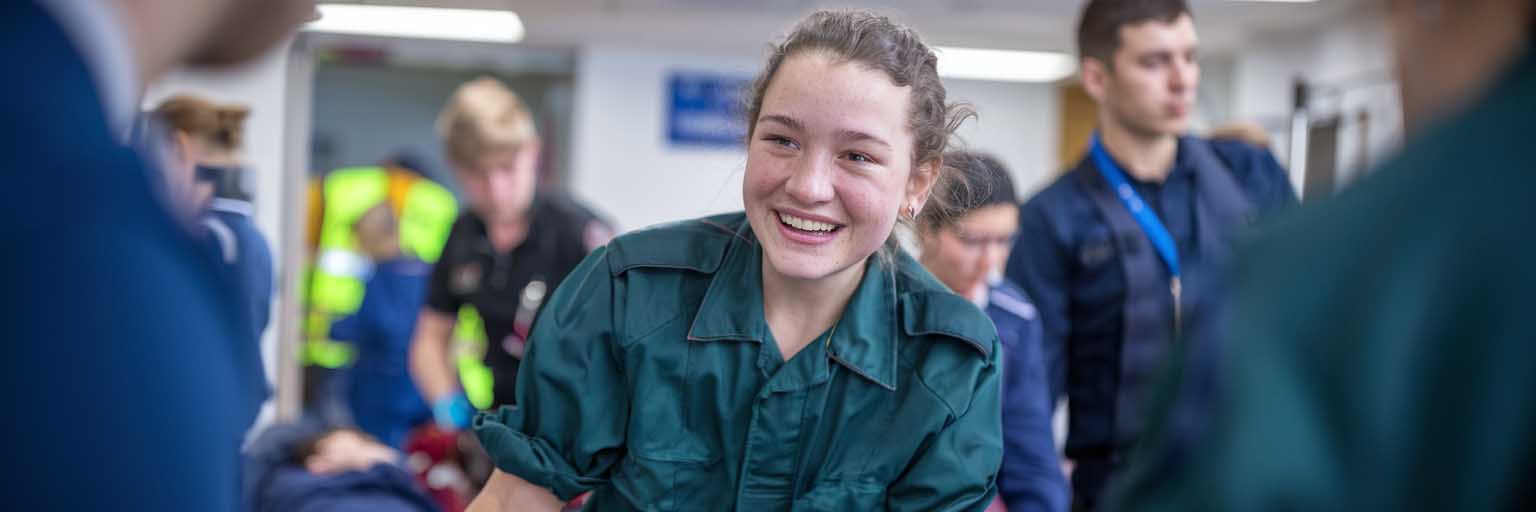
Health and Social Care Level 3
Prepare for a professional career supporting people and communities through an advanced programme combining in-depth social care study with real workplace experience. Equivalent to three A levels, this two-year programme develops the knowledge, professional behaviours and practical experience needed for employment, apprenticeships or higher education.
-
Description
Develop a detailed understanding of social care while applying your learning in real care environments.
Across two years, you will study 23 units covering the knowledge, values and professional behaviours needed to support individuals effectively. You will examine increasingly complex situations and learn how professionals plan care, promote wellbeing and respond to different individual needs.
You will explore:
- Working in social care
- Mental health and wellbeing
- Values and behaviours in care
- Care and support planning
- Learning disabilities
- Dementia awareness
- Infection prevention and control
- Health and safety
- Personal and professional development
- Professional communication
- Supporting individual needs
- Reflective practice
Your classroom learning will be supported by up to 150 hours of work placement in real social care environments. This will help you apply theory, understand professional expectations and develop confidence working with individuals and care professionals.
As you progress, you will be expected to think critically about care practice, apply your knowledge to realistic scenarios and take increasing responsibility for your own professional development.
Alongside your specialist knowledge, you will develop transferable skills such as communication, empathy, teamwork, problem solving, organisation, emotional resilience and professional judgement.
-
Entry requirements
You will normally need:
- Five GCSEs at grade 4 or above, including English and Maths
- Or an appropriate Level 2 vocational qualification, together with equivalent English and Maths qualifications
If you have not yet achieved grade 4 in GCSE English and/or Maths, you will continue to study these alongside your main programme.
You will get the most from this programme if you:
- Have a genuine interest in social care and supporting other people
- Can communicate sensitively and professionally
- Are empathetic and respectful towards others
- Can remain calm and professional in challenging situations
- Are interested in understanding complex individual needs
- Can work effectively as part of a team
- Are willing to reflect on your own practice
- Can solve problems and make considered decisions
- Are organised and able to meet deadlines
- Have the emotional resilience needed for working in care environments
- Are ready to take greater responsibility for your own learning and professional development
At Level 3, you will be expected to approach both your academic work and your placement with maturity, professionalism and increasing independence.
-
Qualification
NCFE Level 3 Technical Occupational Entry Diploma in Social Care
-
Progression
After completing this programme, you can progress into higher education, an apprenticeship or employment within health, social care and related sectors.
Your Level 3 qualification is equivalent to three A levels and provides a strong foundation for a wide range of professional pathways.
Possible next steps include:
- Further study at Newbury College or University Centre Newbury
- A university degree in social care
- Social work
- Nursing
- Counselling
- Mental health-related study
- Health and social care apprenticeships
- Adult care apprenticeships
- Community support roles
- Employment as a care worker
- Personal assistant roles
- Community support work
- Activities coordinator roles
The skills developed through social care can also provide a useful foundation for related areas such as youth and community work, family support, education support or public services, depending on your interests and the entry requirements of your chosen progression route.
With further higher education and professional training, you could progress towards careers such as social worker, nurse, counsellor, mental health practitioner, care manager or other specialist roles supporting individuals and communities.
-
Assessment
The qualification is assessed through coursework-based methods rather than final written examinations.
Assessment includes:
- A portfolio of evidence
- Written assignments
- Projects
- Synoptic assessments based on real-life scenarios
You will be expected to demonstrate not only what you know, but how you can apply your knowledge to realistic social care situations.
Your tutors will provide feedback throughout your assignments and projects to help you deepen your understanding, improve your professional judgement and build evidence of your achievement against the assessment criteria.
Your work placement will also help you connect theoretical learning with professional practice.
Maths and English, where studied alongside your programme, are assessed separately and may include exams.
-
Home study
You should expect to complete around 2 to 4 hours of independent study each week.
This may include:
- Researching social care topics
- Completing written assignments
- Developing portfolio evidence
- Preparing projects
- Working through case studies
- Preparing for synoptic assessments
- Reflecting on your work placement
- Responding to tutor feedback
You will use digital platforms and standard IT equipment to complete and manage much of your work.
At Level 3, you will be expected to take increasing responsibility for planning your workload, meeting deadlines and preparing thoroughly for assessments.
-
Work placement
You will complete up to 150 hours of work placement in a real social care environment.
Placements may include:
- Residential care homes
- Nursing homes
- Day centres
- Supported living
- Domiciliary care
- Community-based services
Your placement will give you opportunities to apply your classroom learning, develop professional communication and experience the responsibilities involved in supporting individuals.
You will be required to complete a DBS check before starting your placement. This will be arranged during induction.
The experience you gain will help you make informed decisions about your future career while giving you practical examples to draw on in assignments, apprenticeship applications, university applications and future job interviews.
-
Fees and additional costs
- All full-time students are asked to contribute £15 towards the College Subscription Fund
- If you are over 18, an additional awarding body registration fee may apply if you have not previously registered
- You may need to purchase textbooks
- You may need suitable clothing for practical activities or work placement
- Optional educational visits, trips and enrichment activities may have additional travel or entry costs, and you will be given information in advance
* Terms and conditions apply. The fees stated on this website are for guidance purposes only and should be checked before enrolment. Unless otherwise stated, fees shown are for tuition only, over one academic year. Where a course is longer than one academic year, the fees stated are for the first year, and the cost of the second or subsequent years will be discussed at interview. For details of fee remission for students over 19 click here. If you think you may be entitled to a concession or fee remission, or you would like more information on the additional costs associated with your chosen course, please contact us on 01635 845000 or email